
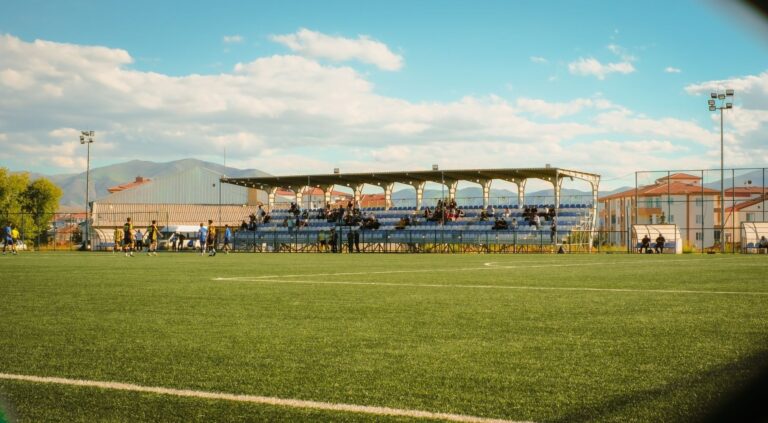
The 5 PM Whistle and the Scramble on Non-League Press Benches
The romantic picture of sports journalism is easy to recognise: a reporter close to the touchline, notebook open, watching the decisive moments unfold before shaping them into polished copy. At non-league level, the reality is considerably more demanding. The press position may be a narrow bench beside a stand, a draughty corner of a gantry, or a table borrowed from the clubhouse. The working day is governed by weather, unreliable technology, changing team news, and the immovable pressure of the final whistle.
At grounds such as Darlington FC, the matchday task can involve wind sweeping across an exposed terrace, freezing temperatures settling into fingers and keyboards, and a basic working area with limited shelter. Yet the report still has to be filed quickly. A Saturday fixture can finish shortly before the 5 PM print cutoff, leaving only minutes to confirm the score, identify the turning points, check the substitutions and cards, and produce a coherent account for supporters. Online readers expect updates immediately, while print schedules allow no sympathy for a late winner or a laptop that has lost power.

Battling the Elements from Tin Gantries to Exposed Benches
Weather is not a background detail for a regional football reporter. It changes the practical conditions of the job from one fixture to the next. A north-easterly wind can make a covered stand feel open to the sky, while rain can turn a notebook into a liability and leave a reporter trying to read handwritten notes through a wet sleeve. At smaller grounds, there may be no dedicated press box at all, meaning the media position must share space with club volunteers, photographers, scouts, or supporters.
Cold creates a particular problem because match reporting depends on constant movement between observation and recording. A reporter needs to write quickly after a chance, a booking, or a tactical adjustment, but thick gloves make that difficult. Fingerless gloves offer a practical compromise, preserving enough dexterity to operate a pen or keyboard while protecting the hand from the worst of the chill. An insulated flask is equally important, not as a luxury but as a way of maintaining concentration through a long afternoon.
Even professional media facilities demonstrate how much infrastructure is required to make sports coverage function smoothly. The San José State media relations guidance describes an open-air press box with wireless internet, telephone lines, post-game access, statistics, quotes, and other support for accredited media. Many non-league reporters work with far less, so preparation becomes part of the craft.
- Fingerless gloves for writing and typing in cold conditions
- A waterproof notebook or protective notebook cover for rain
- An insulated flask to maintain warmth and concentration
- Spare pens, charging cables, and a fully charged battery pack
- A waterproof sleeve or bag for laptops, phones, and accreditation
Technology is especially vulnerable in winter. Laptop batteries discharge faster in low temperatures, touchscreens become awkward to use with damp fingers, and rain can compromise keyboards, charging ports, or mobile phones. A reporter who arrives with only one device and no backup power is taking a needless risk. Batteries should be charged before leaving home, files should be saved regularly, and essential match notes should exist in more than one place.
Hotspots, Dead Zones, and the Great 4G Scramble
Digital reporting has made matchday coverage faster, but it has not removed the logistical problems of older grounds. Many non-league venues were designed long before live blogs, instant team news, and mobile video became part of the football routine. A press bench may have no dedicated media Wi-Fi, limited electrical sockets, and a mobile signal that varies sharply between the clubhouse, the main stand, and the car park.
When the signal drops, the priority is to preserve the information rather than chase publication at any cost. Live updates can be drafted offline, team sheets can be photographed before kick-off, and key events can be recorded in a simple text document until a connection returns. Some reporters use one network for data and another phone as a hotspot. Others identify reliable signal points in advance, even if that means stepping outside the press area after full-time to transmit the finished report.
| Working environment | Typical advantages | Common limitations |
|---|---|---|
| Non-league press bench | Close view of the action and direct access to club staff | Limited shelter, power, seating, and mobile coverage |
| Small clubhouse media room | Warmth, tables, sockets, and easier post-match interviews | Distance from the pitch and possible crowding |
| Modern stadium press box | Reliable internet, statistics, workstations, and communications support | More formal access procedures and less flexibility |
The contrast with a modern arena is substantial. Larger venues may provide stable wireless internet, multiple telephone lines, live data feeds, designated workstations, and organised post-match interview areas. At a grassroots ground, the same reporter may be responsible for observing the match, tracking the score, monitoring the club”s digital channels, gathering quotes, editing photographs, and finding a working connection. The job is not simply to write; it is to build a temporary newsroom wherever the fixture happens to be played.
Ripping Up the Script When the 89th-Minute Winner Lands
A match report is often drafted before the match has truly revealed its story. By the 75th minute, the reporter may have a clear structure in mind: a fast start, a midfield contest, a decisive set piece, or a strong response after conceding. Then an 89th-minute winner changes the entire emphasis. The opening paragraph must be reconsidered, the order of events must be checked, and the closing passage must explain not only what happened but why the late goal altered the result.
The discipline is similar to live score services, where supporters expect immediate, accurate information rather than a carefully polished essay. Official competitions at the highest level also operate around strict schedules and reporting requirements, as illustrated by the NFL”s published league calendar. Non-league football has different structures, but the underlying principle is familiar: deadlines are fixed even when the action refuses to follow the planned script.
- From the 75th minute: mark the current score, identify the leading narrative, and ensure all substitutions, bookings, injuries and major chances are recorded.
- During the final phase: write short factual notes for every significant incident, including the build-up to a goal and the defensive or attacking change that made it possible.
- At full-time: confirm the final score with an official source, check the match clock and scorers, and identify the key tactical or emotional turning point.
- Before transmission: rewrite the headline and opening paragraph if late drama has changed the significance of the game, then complete the report with a concise account of the decisive moments.
Speed cannot come at the expense of accuracy. A booking must not become a sending-off, a deflection should not be described as a clean finish, and a substitution should be attributed to the correct side. The most useful reports distinguish between observation and assumption. Instead of claiming that a player was injured without confirmation, the copy can state that the player left the field during a particular phase and await clarification from the club.
Good match reporting also gives supporters more than a list of incidents. Cards and substitutions matter because they explain how the game developed. A full-back”s booking may change the way an opposing winger is defended. A midfield substitution may restore control or expose space. A late goal may come from a set piece that had been threatening throughout the second half. Even under a 5 PM deadline, the report should show how the result was shaped, not merely announce it.
Why Grassroots Sports Reporting Remains the Lifeblood of Town Communities
Local football coverage carries a different responsibility from national sports journalism. It is close to the people who attend every fixture, volunteer at the ground, sponsor the club, travel to away matches, and remember the players who represented the side decades ago. A regional reporter knows that a match report may be read by a supporter in the stand, a former player at work, a parent following a son”s first-team appearance, or a community member checking the club”s progress from a distance.
That connection gives non-league reporting its value. The work preserves the details that larger outlets cannot cover: the shape of a difficult away performance, the emergence of a young substitute, the manager”s explanation for a tactical change, or the reaction after a hard-earned draw. Organisations such as the North Carolina League of Municipalities emphasise the role of local institutions in connecting civic life with the needs of residents. Football clubs perform a similar function in towns across Britain, acting as meeting points where sporting history and everyday community identity overlap.
- Supporters receive a reliable record of the fixture and its key incidents.
- Players and volunteers gain recognition for work that may otherwise go unseen.
- Managers can explain performances directly to the club”s audience.
- Historic clubs retain an accessible record of campaigns, milestones, and turning points.
- Occasional followers can understand the result without needing to have watched the match.
Access is another important part of the role. Post-match tunnels, clubhouse conversations, and direct manager interviews provide context that a scoreline cannot offer. The local correspondent can ask what changed after half-time, why a substitution was made, or how a depleted squad managed a demanding fixture. That does not mean acting as an unquestioning mouthpiece. A strong club correspondent remains fair, precise, and transparent, giving the community a truthful account while respecting the people who make the football possible.
Keeping the Matchday Voice Alive for the Faithful
Non-league match reporting is built on resilience. It demands clear observation in difficult weather, reliable preparation when facilities are limited, and calm decision-making when technology fails or the match changes dramatically in its closing minutes. The reporter must move from handwritten notes to finished copy with no guarantee of warmth, power, shelter, or a stable connection. Every report is a small exercise in discipline, especially when the final whistle arrives only moments before the deadline.
That effort matters because community football needs a recorded voice. The reporters, photographers, volunteers, and club staff who brave freezing Saturday afternoons keep the story of the club available to supporters, families, former players, and future generations. The next fixture will bring another team sheet, another contest for territory, another spell of pressure, and perhaps another late twist. Whatever the conditions, the responsibility remains the same: watch closely, report honestly, and carry the community club”s story forward.